


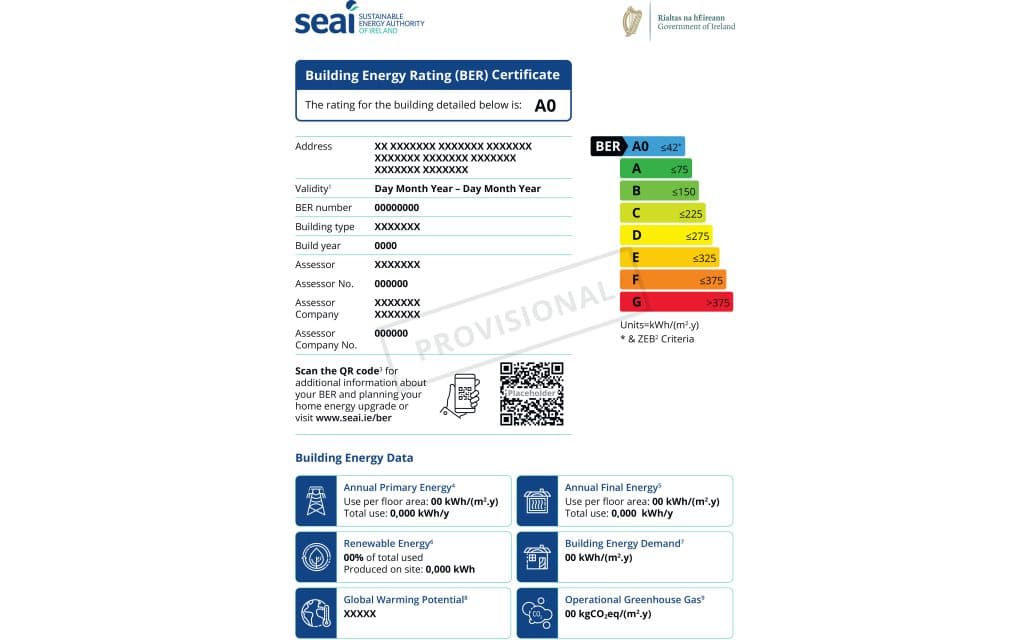
From May 24, 2026, a simplified Building Energy Rating (BER) scale has come into effect for domestic and non-domestic buildings in Ireland. This update is part of the Irish implementation of the European Union’s Energy Performance of Buildings Directive (EPBD). The update aligns the Irish rating scale with those found across Europe, improving comparability and making the ratings easier to understand.
The BER scale has moved from 15 rating levels to a simplified 8-level scale: A0, A, B, C, D, E, F, G. Sub-categories such as A1, B2, and C3 have been removed, and A0 has been introduced as a new category for the most energy-efficient buildings that do not use any fossil fuels.
Updated BER certificates are now being issued, featuring additional information on energy use, renewable energy contributions, carbon emissions, and direct access to BER information and upgrade guidance via a QR code. Existing older-format BER certificates remain valid for 10 years from their date of issue.
So, how could this change impact you? Apart from the obvious visual differences, there are several key updates to be aware of:
Under the Sustainable Energy Authority of Ireland (SEAI) One Stop Shop (OSS) scheme, a primary criterion was achieving a B2 rating. This has now changed to simply achieving a B. Under the old scale, a B2 would have meant a BER or energy value of between 100-125 kWhr/m2/yr. This is the total primary energy use for space heating, hot water, pumps, fans and lighting per year divided by the floor area of the property. Under the new scale, a B is an energy value between 75-150 kWhr/m2/yr, effectively absorbing the old B3, B2, and B1 bands.
Consequently, hitting what used to be a B3 will now land you a B, which is sufficient for OSS compliance. Note that the 100 kWhr/m2/yr uplift (improvement) requirement still applies if you are not installing a heat pump. While this won’t change much for upgrades featuring a heat pump (which generally land in the A band), it will make navigating the OSS grant route easier for projects retaining an oil or gas boiler.
Irish banks typically offer lower interest rates (usually a 0.1 to 0.3 percent discount off standard fixed rates) for energy-efficient homes. Previously, a B3 or better was required to access these green rates, with some lenders offering a sliding scale based on the exact grade. While lenders are still updating their guidance, the new B band is expected to be the benchmark for green mortgage access, meaning little functional change for borrowers. Valid older certificates (A1 through to B3) will continue to be accepted.
Alongside the scale change, updates have been made to the Dwelling Energy Assessment Procedure (DEAP) methodology. Crucially, the primary energy factors and greenhouse gas emission coefficients have been adjusted to reflect the decarbonisation of the Irish electricity grid.
Previously, a primary energy factor of 1.75 was applied to electricity use. This meant one unit of electricity used in the home was calculated as 1.75 units of primary energy to account for generation inefficiencies and grid losses. As of May, 24, this factor has dropped to 1.5.
Because your BER is based on primary energy use rather than final household consumption, this shift impacts final ratings: Most homes will see an improvement, particularly highly electrified homes (e.g., those with a heat pump). However, solar PV will have less impact on your overall BER result because it is now offsetting less penalised primary energy.
To illustrate the impact of the primary energy factor here are a few examples. A home, which I assessed earlier this year, that had been fully upgrade with heat pump fitted, (no PV) ended up with a A2 rating. If I was to republish this today it would end up as an A0. One from last month, with an inefficient oil boiler and solar PV, ended up with a C3 rating. If I was to do it this week the result would be D. Another property with a heat pump and PV, that was an A3, would drop down to a B. While multiple methodology changes occurred simultaneously, the variations above are primarily driven by the new electricity primary energy factor.
Other changes to the methodology include: Solar PV battery storage. The calculation now factors in whether a battery storage system is fitted (which previously had no impact on the BER). Smart Grid Readiness is now considered. There is an option to state whether the building “has the ability to adapt energy use, generation, or storage according to external signals.” This is assumed for homes with heat pumps or solar PV; while it doesn’t alter the energy value, it is a prerequisite for hitting an A0. Additional minor adjustments have also been rolled out for lighting calculations, heat pump water efficiency metrics, and fossil fuel use.
As always, if you would like to get in touch about anything in this article or your own retrofit project, feel free to reach out: [email protected].