


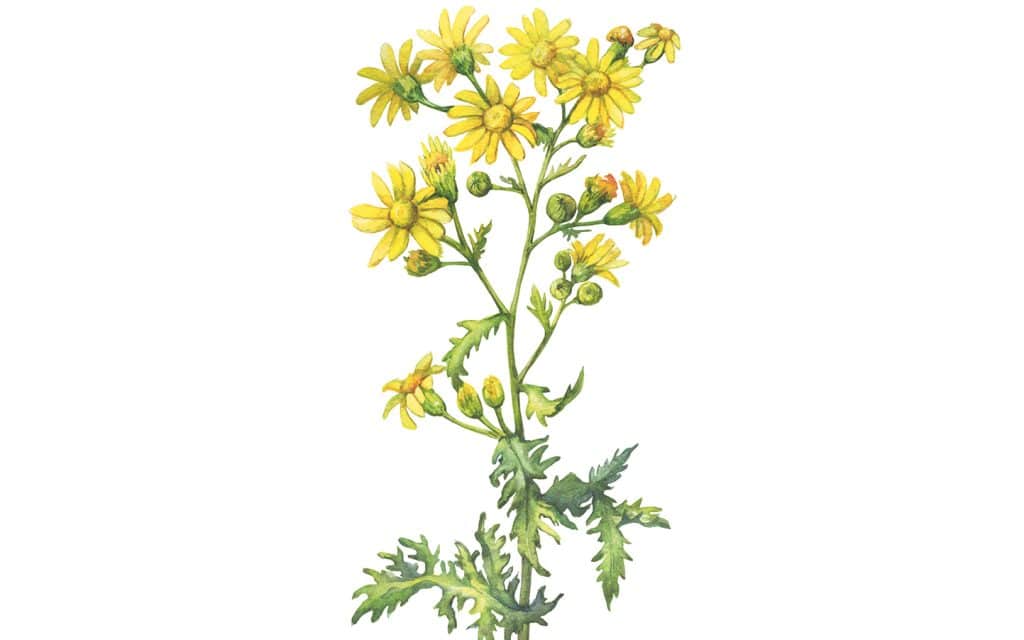
When I was young, I recall being intrigued by a poster in the Post Office warning farmers that they could be prosecuted for having noxious weeds growing on their land. The full list I have forgotten but it certainly included ragwort, dock and, I think, thistle. We are constantly trying to eliminate weeds from our gardens. Sometimes I find this hard to do because these so-called weeds are often beautiful and were once used widely in folk medicine and for other uses.
Ragwort, with its bright yellow, daisy-like flowers and toxic leaves, was regarded as a fairy plant to be treated with caution. It is known in Irish as Buachalán Buí, with alternative names such as Balcaiseán, Bóthanán, Buafalán, Gaosadán, Coiseog Bhuí and Las San Séan (Plant of St James). In English it has several alternative names including Bohalawn, Fairy Horse, James’ Weed, Ragged Jack, Staggerwort, Yellow Boy, etc.
In ancient Ireland it was believed that ragwort was used like a horse by the fairies to ride around on. Their favourite time for doing this was Hallowe’en and many stories tell of unfortunate people abducted and forced to ride around with them all night, only to wake the next morning exhausted, clutching the ragwort in their hands. However, the fairies could also be more generous. A well-known folktale relates how a fairy host takes a man with them on a magical journey. They give him a special cap and tell him to mount a ragwort as if it were a horse. He finds himself flying through the air and landing in a wine cellar in a foreign country. There he drinks his fill, but the next morning he finds himself alone and is then arrested for breaking into the wine cellar. He is sentenced to be hanged, but before the rope can be put around his neck, he manages to reach into his pocket and put on his fairy cap. He is lifted up into the air and brought back home, to be left standing beside the ragwort at the very spot where he first met the fairies. An old song describes the fairy ride: ‘Is gur shiúil mé na cúig cúigí; Is gan fúm act buachallán buí’ (And I travelled through all the provinces with nothing under me but the ragwort). A Sligo saying reflected the caution generally shown in Ireland towards ragwort: ‘Don’t call it a weed, though a weed it may be, ’tis the horse of the fairies, the booholaun buidhe’.
In the Scottish highlands, it was said that the fairies sheltered beside the ragwort on stormy nights, and also rode astride it on their journeys in the Hebrides, from island to island. Witches and warlocks were also believed to ride around on ragwort stems, as well as the more usual broom. A poem by Robbie Burns describes the devil and his witches and warlocks riding together: ‘Let warlocks grim, an’ wither’d hags / Tell how wi’ you on ragweed nags / They skim the muir (moors) an’ dizzy crags / Wi’ wicked speed.’ In Scotland, after the battle of Culloden, the victorious English are said to have named the garden flower ‘Sweet William’ in honour of their leader, William, Duke of Cumberland. The defeated Scots (who were massacred cruelly by the English) retaliated by giving ragwort the name ‘Stinking Billy’. Alternatively, the Scots maintained that the spread of ragwort throughout Scotland was due to the rampage across the land by the Duke of Cumberland’s troops during the Culloden campaign. Ragwort is the national emblem of the Isle of Man, perhaps because of the island’s nickname, ‘Ynn Ellan Shiant (The Fairy Isle).
Ragwort’s association with the fairies was believed to give it other magical properties. A Donegal folktale tells of a man with fairy power who used to turn a bunch of ragwort into the form of a pig. The man brought the ‘pig’ to a fair and sold it, but as the unfortunate buyer was driving it home, he crossed running water and the ‘pig’ instantly turned back into a bunch of ragwort. In places it was believed to be bad luck to strike a cow with the flowers of ragwort because it meant the ‘wee folk’ would be sure to come and steal the cow’s milk.
Ragwort was called the ‘herba Sancti Jacobi’ (the herb of Saint James) whose feast day is July 25 when the ragwort is in full bloom. Interestingly, in view of the ragwort’s role as a ‘fairy steed’, St James is said to be the patron saint of horses.
Ragwort is despised by farmers because its leaves are toxic to livestock. Despite this, ragwort features in several Irish cures. The leaves were used in many places as the basis for poultices and the juice was used for curing cuts, sores and inflammation, including burns, scalds and boils. Perhaps because of its yellow colour, ragwort was also considered as an effective cure for jaundice. Ragwort was also used for treating coughs, colds, sore throats, rheumatism and sore joints. In West Cork, ragwort was used to make brooms and brushes for sweeping the house. In Scotland and Ulster ragwort was put in with oats when they were stored to keep mice away.