


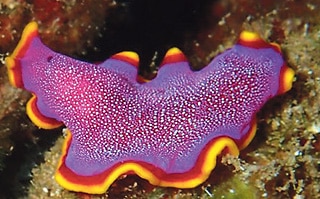
I was recently shown a photograph of something from a local beach that I hadn’t noticed before. It resembled a giant honeycomb growing over a mussel-covered rock. The thing was a colony of Sabellaria alveolata, the honeycomb worm. The individual worms are only about four centimetres long, but each builds a tube made of sand grains and tiny pieces of broken shell, all stuck together with mucus, which is attached to neighbouring tubes, forming an extensive colony that looks like something a bee or wasp might have made. At low tide, the worm hides inside the tube, but when the tide comes in, it extends its tentacles to catch microscopic food particles. Most Sabellaria reefs are found between tide marks, although the largest one in Ireland, the Wicklow reef, is sub-tidal.
The word ‘worm’ doesn’t apply precisely to any one group of animals. Some creatures are called worms that are not worms at all – I wrote before about the shipworm, which is a bivalve mollusc. A woodworm is a beetle, so is a glow-worm; an inch-worm is a type of caterpillar, a slow worm is a legless lizard. Several other unrelated creatures, most known only to zoologists, are called worms too, such as arrow worms, acorn worms, bootlace worms and tongue worms.
The worms that ordinary people are most likely to encounter belong to the phyla Platyhelminthes, Nematoda and Annelida. The platyhelminths are the flatworms, tapeworms and flukes. Flatworms are mostly free-living. Some are brightly coloured sea creatures; others are invasive garden pests such as the Australian and New Zealand varieties. Tapeworms resemble very long strands of tagliatelle, made up of dozens of units that are actually bags of eggs. They are all parasitic, living in the digestive systems of many vertebrates from fish to pigs, and humans too if you don’t cook your meat adequately. Flukes are also parasitic; the best known in Ireland is the liver fluke, Fasciola hepatica, which infects sheep and cattle. The serious tropical disease, bilharzia, is caused by a fluke called Schistosoma.
The most abundant worms are the nematodes or round worms. There are many thousands of species, mostly microscopic, living in every known ecosystem from the Arctic to the ocean floor; in some soils, there might be a million nematodes per square metre. Many roundworms are parasites; those of the family Anisakidae are common in fish; eating raw fish can lead to anisakiasis which, not surprisingly, is common in Japan. In the tropics, other nematodes cause more horrible afflictions, such as elephantiasis and river blindness.
The annelids are segmented worms; their bodies are divided into many sections, each with copies of all the important organs. There are three classes of annelids: Oligochaeta, the earthworms; Hirudinea, the leeches; and Polychaeta, the marine worms.
There are about 10,000 species of oligochaetes, most living in soil, some in freshwater. Common earthworms, Lumbricus terrestris, are vital to soil quality, because their burrowing carries nutrients such as leaf litter, as well as air and water, from the surface down into the soil; Charles Darwin’s last book was on that subject. The worms that live in your compost bins – you all have compost bins of course – are brandlings, Eisenia fetida.
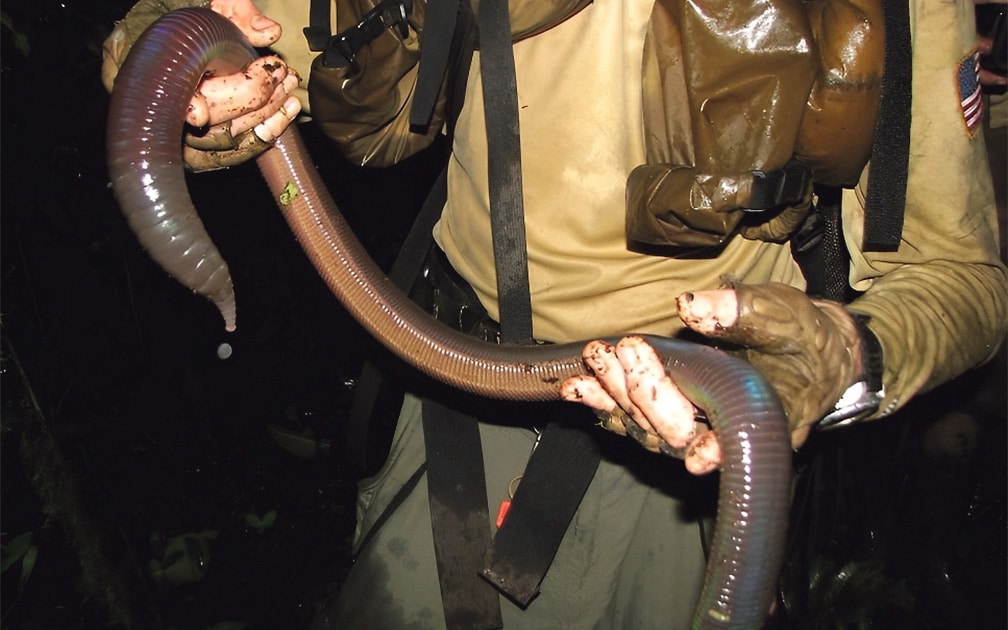
The longest earthworm in Europe is Lumbricus badensis from the German Black Forest, which grows to 60 centimetres, but the real monsters belong to the family Megascolecidae, e.g. the giant Gippsland earthworm from Australia, which can reach two metres.
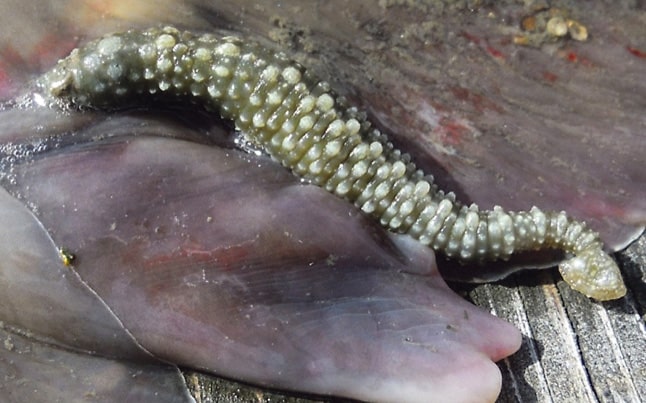
Leeches are similar to oligochaetes, except that they have a sucker at both ends, used for locomotion (they move in the same manner as inch worms) or for attachment to a host. There are over 600 species, three-quarters of which are blood-suckers, the rest free-living predators. Fishermen might be familiar with a large leech called Pontobdella muricata, which lives on skates and rays. The medicinal leech, Hirudo medicinalis, has been used for centuries for the spurious cure-all of ‘blood-letting’. Today, doctors use them to reduce swelling and restore circulation after microsurgery, and also to treat varicose veins. When I was doing a frog survey in Malawi, I spent most evenings wading around at the edge of a small lake, and when I got back to my hut and took off my boots, there were often leeches inside, sucking away at my blood.
The last group of annelids are the polychaetes. There are also about 10,000 species, divided into two sub-classes: Sedentaria and Errantia. The lugworm is one of the former. It leads a dull life in a U-shaped burrow in muddy sand, above which, as every shore angler knows, is the cast – that coil of sand that has passed through its digestive system. Other sedentary polychaetes live in tubes made out of mucus and sand or fragments of shell, e.g. the peacock worm and the sand mason worm, both common on the lower shore. The honeycomb worm belongs to this group.
Some sedentary worms make calcareous tubes: Spirorbis, whose tube is coiled like a tiny snail shell, lives attached to rocks and seaweed; Pomatoceros, which makes long, white wiggly tubes, is often seen on rocks, shells and fishermen’s buoys.
Many tube worms have feathery, fan-like tentacles that can resemble beautiful flowers. The Christmas tree worm, Spirobranchus giganteus, found in tropical seas, has two fans made of several whorls, each looking like an artificial Christmas tree.
The Errantia contains active, predatory worms. Ragworms, also used as bait by anglers, have “parapodia” or false legs growing out from each segment, with which they crawl or swim. Unlike lugworms, they have tentacles, eyes and, in some species, big sharp jaws. The sea mouse, Aphrodita aculeata, which you might find at extreme low tide, looks more like a drowned mouse than a worm, being short, fat and hairy, but its bristles shine in gorgeous iridescent greens and purples. Another group, the gossamer worms, are specialised for life in the plankton, where they paddle about emitting a yellow bioluminescence at night.
Most annelids are harmless, though there are exceptions. The Mongolian Death worm from the Gobi Desert can kill humans by squirting a deadly poison; just touching this worm is fatal. Fortunately it only exists in the minds of cryptozoologists. But fireworms, found on tropical coral reefs, have bristles which contain a toxin that can cause pain, irritation and nausea. The larger errant polychaetes can give you a nasty bite. One species is especially scary – the trap-jaw worm. This creature, which can grow to nearly three metres in length, spends its time buried in the sand around Indo-Pacific coral reefs. When it senses a fish nearby, it lunges up out of its burrow, and its huge open jaws snap shut on the surprised fish, which is then dragged down into the sand. A reef fish called Scolopsis affinis has learned how to retaliate by squirting jets of water at the worms.
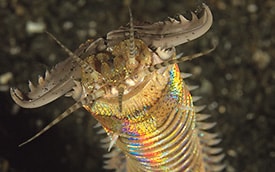
Zoologists are forever changing the classifications that I learned years ago. Beard worms, for example, once in their own phylum, Pogonophora, are now classified as annelids. The best known of these is Riftia pachyptila, a giant tube worm that can also grow to three metres. It lives around hydrothermal vents deep in the Pacific, part of a community of animals adapted to darkness and temperatures as high as 380 degrees Celsius. Also now placed among the annelids are the sipunculids. I was once very pleased to be able to identify a plateful of these unimpressive worms in a restaurant in Xiamen, China, where they are a local delicacy. They came in a sort of jelly, and like so many odd things the Chinese eat, tasted only of soy sauce, garlic and ginger.
The Chinese are not the only ones who eat worms. The palolo worm, similar to a ragworm, is very important in the South Pacific. Cork-born writer and artist Robert Gibbings, in his book ‘Over the Reefs’, described their capture in Samoa. On just a few nights in October or November, when the moon is in its last quarter, the palolo rise to the surface in great writhing masses and release their reproductive segments, which are the edible bits. They apparently taste better than oysters but smell like the reef at low tide.
To the average person, worms are disgusting, squirmy things, and parasitic worms are so unpleasant that anyone without an understanding of natural selection must surely wonder why they exist at all. Sir David Attenborough (who is 100 years old this month) uses the nematode that causes river blindness to explain his agnosticism – how can a merciful god have created a worm which lives only by burrowing into a child’s eyeball?
But the majority of worms are unobtrusive, some are quite beautiful, and many are important environmental engineers; even the nasty ones have ingenious life-cycles. We should be fascinated by worms, not be disgusted by them.