

West Cork seems to have its own ‘musical ecosystem’. Musicians playing in each others’ – often intersecting – bands. Gigs aplenty. In most genres under the (not very present) sun: Blues, trad, rock, world music, jazz, country, post-punk, alternative, classical. And yes, reggae. Music with a strongly accented sub-beat, originating in Jamaica, that evolved in the late 1960s. Most notably played by two bands in West Cork that partly overlap: Mango Moon and the West Cork Dub Collective.
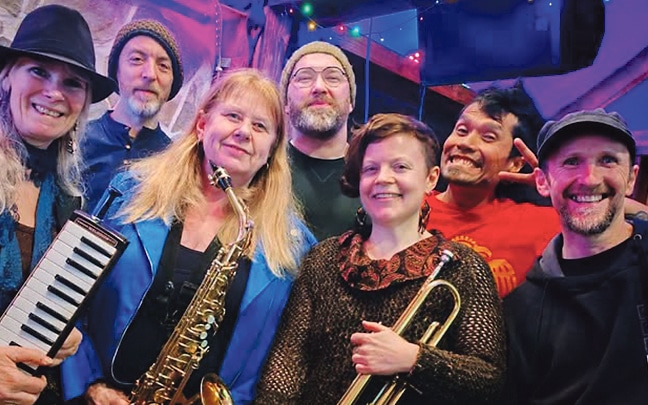
Mango Moon started with a casual conversation in 2021, as Caz Jeffreys said to Kate Liddell, “Wouldn’t it be cool to have a reggae club in Ballydehob? Next I got five of us together for a reggae jam.” Soon afterwards, Mango Moon’s original line-up featuring Caz (vocals, electric guitar), Kate (trumpet, fiddle, vocals), Jane Goss (sax, vocals), Greg Woods (bass), Patrick Healy (rhythm guitar), Ben Crockett (drums) expanded as with the Mexican percussionist, Armando Ramirez, joined them.
According to Caz, “My initial idea was to create a kind of club in the basement of Oasis Arts Café in Ballydehob, also for other musicians, but, within weeks, we were invited to play a gig. And lead guitarist Rik Appleby came on board. We became a band very quickly, were building up more songs, gigging. Until Greg, our bass player, fell sick. Sadly, he passed away in early 2024. For a while, I didn’t know if I wanted to carry on but eventually we continued as a seven-piece. Rik transitioned to bass. And since February this year we’re on our third drummer, the brilliant Steven O’Connell.” Apart from reggae – “our backbone” – the band plays ska (a forerunner of reggae) and dub.
In the beginning, Caz Jeffreys supplied all the original material. “Roughly 50 per cent is still mine, the rest are covers. Jane has also written songs while she and Kate often write their own parts so we’re increasingly co-creating.” A party piece is the instrumental Swing Easy, recorded in the 1960s by the Skatalites, a band consisting of the musicians behind many of Jamaica’s hit records. “Swing Easy gets everyone going,” says Caz. “Some people keep dancing all night. It’s so great to connect with the audience in this way. And, the same people come back time and again. It’s like a community.” A word that is frequently used to describe Mango Moon’s musicians’ external activities. Some have MAs in community music (or music theory). Jane Goss conducts community choirs in Dunmanway and Castletownbere. Caz Jeffreys used to lead numerous community choirs (not to mention community bands, even a community musical) but is now creating music installations for community involvement and has set up Creative Voice Projects for fairly experienced female singers. “We don’t just learn great songs and complicated harmonies but also look into what has held us back from doing what we want to do or feeling confident about performing. These are eye-opening and moving conversations, which are now inspiring newly written songs.” Meanwhile, Kate Liddell has embarked on a solo performance project involving a loop pedal, vocals, and multiple instruments.
Last summer Patrick Healy, Rik Appleby, Armando Ramirez and then-drummer Fergal Lee set up the West Cork Dub Collective while continuing to play with Mango Moon. They rehearsed twice. “We chose rhythms from 70s and 80s classic dub tunes alongside chords and a bass line. That’s always our springboard.” So far, they have been doing gigs every four weeks, currently in Ár n-Áit in Skibbereen on the first Saturday of the month. And every performance is different. The main ingredient, apart from those chords, rhythms, bass lines, is slightly mysterious: dub.
“Dub started back in Jamaica when reggae was evolving,” shares Rik. “The music producers would record reggae singers and create their own mix based on that recording. And then another version, as they removed a lot of vocals while adding loads of effects. The end result was an instrumental that focused on the rhythm section. A production idea that turned into a style.”
“It was the art of using the studio and/or the mixing console as an instrument,” adds Patrick. “As part of the band. It’s about space and the creative manipulation of sound. Dub is certainly heavier than reggae, with prominent bass and drums while echoes and extra reverb are thrown in. We are also creating those effects, live.”
Different guest musicians are invited for each Dub Collective gig. So whereas the musical points of departure are always the same, improvisation is the norm so the outcome cannot be predicted. It could be a danceable, vibrating wall of sound dominated by heavy guitar sounds or something entirely different involving a lyrical silver flute, baritone sax, vocals.
Rik says the band are “working on some recordings from our October gig when the Grammy-Award winning guitarist Niwel Tsumbu, Congolese-born and Ireland-based, was playing with us, as well as Julia Cross on flute and vocals. The sound just took off into areas that were completely unplanned and exploratory and new. Nobody had any idea what was going to happen and it went to really interesting places.”
Their dedication to reggae goes far, has deep roots, and started early. “In Donegal we have the annual community-based Mary from Dungloe International Arts Festival,” says Patrick. “When I was five, my parents brought me along to listen to the Century Steel Band, an Irish reggae-outfit. My dad mentioned to me recently, “It’s no wonder you love reggae so much because you were dancing away when that band was playing.”
Rio’s grandmother lived in a flat in Hackney. “When I was very young, some Rastas lived next door to her. You could hear their reggae through the walls, especially the bass and drums. My nan called it jungle music but as a child I found it deliciously exotic. In my late teens I realised it was something that I could play quite easily as I had a feel for it. I would listen to the sound systems in London. Really heavy dub and very heavy bass. The effect is physical; almost like a physical meditation. You can feel your body vibrating in sync with the music.”
“Maybe reggae is so attractive because it can slow things down,” says Patrick. “Pace the breathing. In our busy, hectic world that steadiness is really appealing.”
West Cork Dub Collective plays Ár n-Áit in Skibbereen on March 7.
DMac Burns and Mango Moon play Connolly’s of Leap on March 16.
Caz Jeffreys runs Creative Voice Projects in the Ludgate Hub (Skibbereen) and at Civic Trust House (Cork).
Mamacha (with Kate Liddell and Armando Ramirez) plays Levis Corner House on April 12.
Patrick Healy puts his music on Bandcamp as Emerald Lion (a collaboration with Mark Dorrian).
Rik Appleby releases reggae and dub productions on Bandcamp as Lionheart Recordings.