

Whatever one’s opinion of Venezuelan president Nicolas Maduro, the world was left open-jawed at the audacity of the move by US military forces to seize the president in one pre-ordained swoop so he could be placed on trial in New York for criminal charges. Maduro by all accounts is a tyrant. He has been responsible for electoral fraud, control of the media and suppression of opponents, ironically all very reminiscent of the very man who ordered his capture. He is also the leader of a sovereign country and therefore outside the jurisdiction of the US judicial system, despite having been indicted by American authorities.
At least it’s one less despot in the world I hear some of you say! What’s the problem if it makes life better for Venezuela? If their reasoning was simply to rid the world of despots, why not take out Putin of Russia, Kim Jong Un in North Korea, Khamenei of Iran, Netanyahu of Israel, Museveni of Uganda, Bashar al Assad of Syria? Well, we know their motivation because Trump told us… He wants their oil. It was brazen, bold, typical American imperialism, serving only American interest and not that of the country it supposedly ‘rescued’ from Maduro. In the meantime, María Corina Machado, the primary leader of the democratic opposition in Venezuela, has been side-lined by the Trump administration. This is the same woman who was recognised by the international community with the Nobel Peace Prize. Ignoring her pleas, Trump has declared he will now rule Venezuela; he brazenly posted a doctored map of the world on social media showing Venezuela, Canada and Greenland emblazoned with the ‘stars and stripes’.
The current en vogue phrase coming out of the Oval office is ‘spheres of influence’, but this has been how the United States has conducted its foreign policy for centuries. The US, overtly and covertly, interfered and agitated within other countries for their own imperialist desires, despite the image of being anti-colonial. As far back as 1823, when the US was barely out of new nationhood nappies, the so-called Monroe Doctrine – named after President James Monroe – became the backbone of future US foreign policy. On balance, it was a way to protect itself, given that European countries still occupied large parts of the continent of America, the Caribbean and Canada. The crux of it explicitly stated that the US maintained a right to interfere in Latin America for its own purpose. However, this mentality was not confined to Latin America. When Britain and France were at their zenith at the turn of the 19th century, Spain was long in decline as a world power. During the Spanish-American war of 1898, President McKinley annexed the Philippines. After defeating the Spanish, America stayed for a while – almost fifty years – before granting independence to the Philippines in 1946.
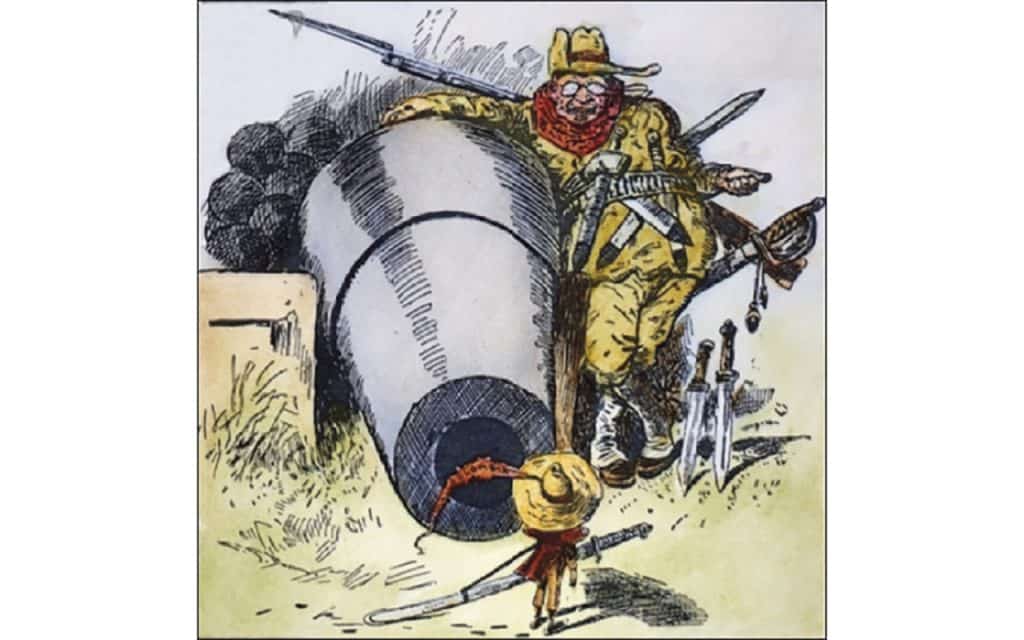
Enter Theodore Roosevelt, a racist imperialist and someone who would make even Trump blush. He believed in racial supremacy and displaced thousands of native Americans, reportedly declaring “I wouldn’t go as far to say that only good Indians are dead Indians but…”. He is infamous for his role in the Panama Canal, which was then a province of Colombia. It remains one of the greatest engineering feats of the 20th century, albeit its construction came at a great cost to human life. Colombia refused to allow the Americans to complete the canal that the French had started but failed to finish. The United States did what it has often done: it supported an insurgency in Panama in 1903 to break the territory away from Colombia, enabling it to negotiate directly with the new Panamanian government and secure a highly favourable deal – an approach not entirely dissimilar to how Trump leveraged Ukraine’s urgent need for US military support to extract a major mineral agreement. This amounted to Panama granting the US “in perpetuity” the rights, power, and authority over a 10-mile-wide canal zone. They held it until Jimmy Carter, an anomalous and genuine president, halted drilling in Alaska through a land preservation act, installed solar panels on the White House, and returned control of the Panama Canal to its host nation in 1977, much to the disbelief of the hawks in Washington. During the Panama fiasco in 1903, Roosevelt’s administration also expelled the Spanish from Cuba, but compelled the Cubans to include a provision in their constitution that would allow the US to maintain a base at Guantanamo Bay indefinitely – unless both countries agree to change it, which, of course, has never happened. (Are you watching Greenland?!) It wasn’t the only Caribbean island to be bullied. The United States occupied both Haiti and the Dominican Republic, governing them through a military administration for nearly a decade, from 1916 to 1924. Ironically much of this happened under the watchful presidency of Woodrow Wilson who, speaking out both sides of his mouth, told the Europeans at Versailles in 1919, that they needed to dissolve their colonies and allow self-determination.
After World War II and the advent of the Cold War, President Truman, in 1947, created the CIA, with the objective to ‘conduct covert action abroad, as directed by the President’, as stated on their website (no joke). Covert is a key word here and probably the main difference between Trump and his predecessors. A country that for so long sold the world the line that they were the world’s policeman, had no one policing them! Countries that elected left-leaning governments became prime targets. The most famous example occurred during President Kennedy’s tenure – the Cuban Missile Crisis. Its roots were planted a year earlier, in 1961, when Kennedy attempted to overthrow Fidel Castro using CIA-trained Cuban exiles. That went disastrously wrong and undermined his reputation. He recovered somewhat in 1962, getting the Soviets to publicly withdraw missile bases in Cuba, while while secretly arranging for the United States to dismantle its nuclear bases in Turkey, which were within striking range of the USSR.
Chile elected their socialist leader, Salvador Allende, in 1970, in an open and fair election. He wanted to drag his population out of poverty and his programme of nationalisation went on to hurt capital interests in the USA. His rule was also an inspiration to other poor Latin American countries to follow suit. It was incredible that he won the election at all given that the US spent tens of millions of dollars on undermining the Chilean elections from 1964 on under the watchful eyes of President Johnson and then President Nixon. (I hope by now you see that whether the president is a Democrat or Republican, it amounts to just different shades of the same thing). When that failed, the CIA orchestrated a military coup in 1973, allowing general Pinochet to take over and begin his bloody regime including implementing torture and death camps. It also prompted the period of the ‘Disappearances’, during which any opponents were arrested and never seen again. This was also happening in Argentina under Jorge Videla and the military junta who, from 1976, got the green light from president Ford to, at all costs, go ahead with his violent repression of left wing opponents. President Ronald Reagan sanctioned the CIA to train the Contras, a group set up to dispose of leftist Daniel Ortega of Nicaragua. In this instance he failed, instead crippling the country with economic weapons and creating an improvised nation that has forced hundreds of thousands to flee illegally to the USA for a better life. A generation on and they now have to face ICE.
America’s best-known international geopolitical bullying is what the Vietnamese call ‘the fight between the elephant and the grasshopper’. This escalated into an all-out war between the military might of the US ‘elephant’ and the tiny Viet Cong ‘grasshopper’. While the Vietnam War was not strictly a covert operation, President Johnson downplayed its escalating costs even as many American cities faced deepening poverty and racial unrest. Even countries with little military or political power, like the mineral-rich Congo, became targets of US foreign policy. Patrice Lumumba was elected in 1960 as the first democratic leader of the Congo, a former Belgian colony. He leaned towards the communist ideal of nationalisation and socialist policies. President Dwight Eisenhower, a military hero who fought against the dictatorial power of the Nazis, had the CIA support a coup, after which Lumumba was tortured and executed in 1961. Another famous example of a socialist-leaning African leader whose administration was undermined by the US in the same era is Kwame Nkrumah of Ghana, who was overthrown abroad, in a 1966 coup orchestrated by the CIA.
Each of these events deserves an article in their own right and each makes a fascinating study of American foreign policy. In our own time, we have seen presidents Bush, Clinton, Obama and Biden conduct wars of ‘liberation’ in Kuwait, Iraq, Afghanistan, and for what? To destabilised countries, a move that ultimately enriches the US. Presenting these events together in this article (and this is far from a comprehensive list) illustrates the far-reaching and often harmful influence of US foreign policy around the world.
Political commentators have said that Trump and his policy makers are destabilising the world. While this statement is correct, you would be mistaken in thinking that Trump is an aberration. American presidents have been destabilising the world for over two centuries. The key difference today is that Trump makes no effort to conceal his actions or maintain the pretence that the United States acts as the world’s benevolent policeman – it never truly did.