


With the weather here so frightfully cold, let me take you once again to the tropics. Last autumn, I stayed with a friend in Kenya, in a village beside the Indian Ocean. Long ago, this village was home to powerful Arab slave traders; their descendants still own much of the place. The streets are made of sand, the houses of coral rock with tin or straw roofs. There are seven mosques. A narrow creek winds inwards from the sea between thick woodland. On the village side of the creek, a couple of fishing boats – long, narrow, open boats with outboard motors – rest on a patch of sand. Opposite, there is a mangrove forest, where male fiddler crabs wave their enormously over-sized right claws to defend territory and attract females, and mudskippers (terrestrial fish with bulging eyes) crawl and jump about in the slobby sediments. Beyond that, overlooking the ocean, there are several very fine houses; one used to be owned by Denys Finch Hatton (lover of Karen Blixen, who wrote ‘Out of Africa’). Around the headland is an almost empty beach of white sand and waving coconut palms.
Low tide exposes what was once a coral reef, now a maze of rock pools filled with sea urchins, brittle stars, cowries, hermit crabs and all sorts of tiny fish. Black-headed herons and woolly-necked storks stride across the coral in search of fish and crabs, while various waders poke about for small invertebrates. At certain times of the year, green turtles haul themselves up the sand to lay their eggs.
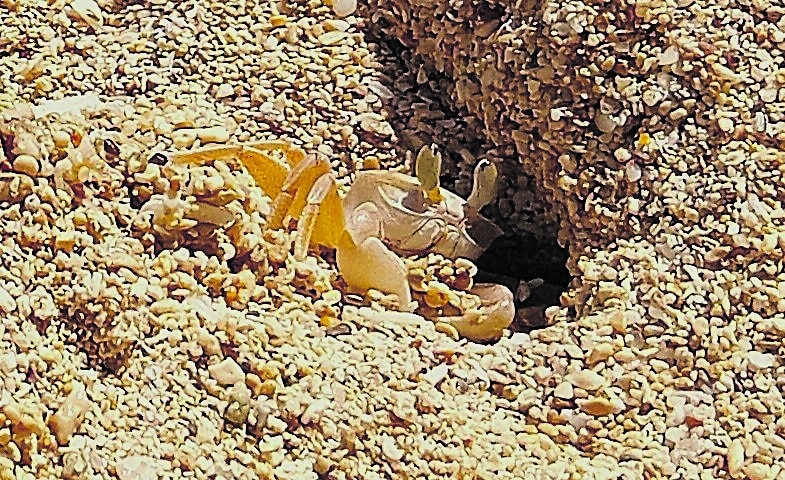
The beach is home to many ghost crabs, always busy carrying out maintenance to their burrows. Emerging cautiously from underground, their eyes literally on stalks, they bear armfuls of sand, which they throw out onto the beach. If disturbed, they rush back into their holes, or hurry away, sideways, across the sand.
Under the water, as far as I dared to snorkel, there were a few small, colourful fish and the odd sea cucumber. The latter belong to the same phylum as starfish and sea urchins, but they are not as attractive. The one I saw rather resembled a length of drisheen; other species look like knobbly cucumbers. They feed by trapping detritus in their cauliflower-like tentacles, which they then push into their mouths one by one, as if they were licking their fingers. For defence, they eject tangles of sticky threads, or in some species, most of their internal organs, at any potential molester. They are in great demand in China, both for culinary and medicinal purposes – they are thought to be beneficial in the treatment of arthritis and certain cancers. But they mature slowly and, living in shallow water, are easily collected and overfished.
To remedy this, I once had a plan to farm sea cucumbers in Tanzania. However, lacking finance, aquaculture experience and courage, I went to China to teach English instead. There, I discovered that sea cucumbers can cost up to £300 per kilogram. What money I could have made! I tried a cheap variety in a restaurant once; it was chewy and tasted only of its sesame oil and garlic dressing.
One day while snorkelling from that beach I came across a pair of porcupine fish at a cleaning station. Porcupine fish belong to the same order as puffer fish and like them, if attacked, blow themselves up into a ball. They are not as toxic as puffers but, being covered in spikes, are very difficult to swallow. These particular porcupine fish were motionless under an overhanging rock, while several cleaner wrasse – relatives of our own cuckoo and ballan wrasse – went to work removing parasites from their spiny skins.
There are many species of fish, and shrimps, that act as cleaners. It is an interesting phenomenon. Fish that want to be cleaned go to specific locations where they have learned that there will be cleaners waiting. It is rather like going to the hairdresser. Cleaner wrasse are small with distinctive patterns, usually dark, longitudinal stripes, which the client fish recognise (the ones I saw were bluestreak cleaner wrasse). The client fish is much larger than the cleaner, and could easily swallow it – the cleaners often work inside gills and mouths – but they consider having parasites removed more important than a quick snack. Some other fish mimic cleaners, fooling client fish so they can get close, for protection or to steal food without doing any cleaning. (Fish such as lumpsuckers and ballan wrasse are used, controversially, in fish farms to remove parasites from caged salmon, but that is another story.)
There were never many humans on the beach, and hardly any tourists. Beyond the reef, fishermen used ring nets to catch wolf herrings and half-beaks. The former are like very long herrings with big sharp teeth. They are good to eat, but terribly bony. Half-beaks are relatives of garfish and flying fish; they have large pectoral fins, and elongated lower jaws, but very short upper jaws. Poorer fishermen, with snorkels and home-made spear guns, hunted for whatever they could catch, which was not much.
A young man was sometimes digging in the sand with his hands, like a dog. He was after the ghost crabs, animals barely two inches across. He told me they made “good relish”. Other men chipped rock oysters off the coral, and searched for anything vaguely edible or saleable. They reminded me of something I’d seen in China: men digging in the sand or looking in rock pools for tiny shellfish or crabs to take home and stir-fry – except that those Chinese men were not poor and hungry. (I see this now in Ireland too, unfortunately).
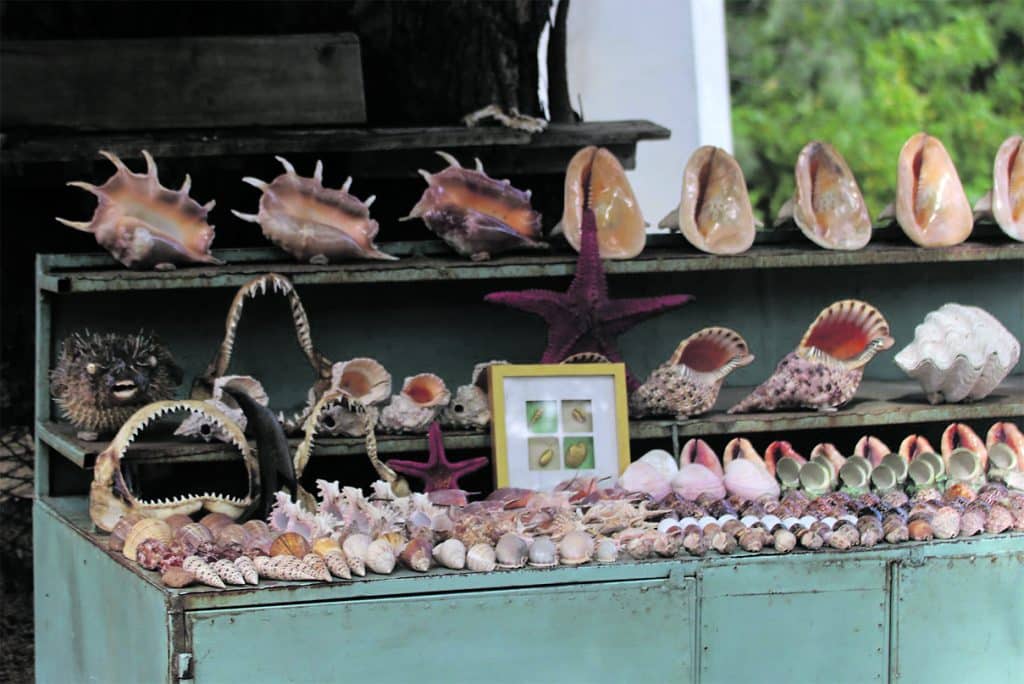
It is rare to find a big shell on a Kenyan beach, because of the souvenir trade. In Malindi, a town to the north, I came across a stall selling sea shells, including rare and endangered helmet shells and giant tritons, as well as dried starfish, dried porcupine fish and sharks jaws. Only foolish tourists would buy them, as it is illegal to take such souvenirs out of Kenya; other African countries are not so strict. Please, if you see dried sea creatures and shells for sale on your holidays, do not buy them.
Something I didn’t see on that beach – very, very unusual in Africa – was rubbish. It was probably cleaner than most beaches in Ireland. My friend and her neighbours who care about the environment pay a team of previously unemployed young men (as a third of all young Kenyans are) to pick up the litter.
Fishermen in Ireland who think they have a tough time should think again. I used to live in Mombasa, teaching in a school near another beautiful beach. There were once many fishermen living along that coast, but because of ‘development’, they were all forcibly moved to make way for hotels and big villas belonging to wealthy foreigners and politicians. So now those fishermen have to carry their nets from their new homes, in an insalubrious suburb a couple of miles inland, down to their boats on the beach, and in the evening trudge with dripping nets and baskets of fish, if they have any, all the way back.
In the harbour north of my friend’s home, I saw three large Chinese fishing boats at anchor, part of China’s massive distant water fleet that is plundering African fish stocks (often, it is alleged, illegally). The Chinese even export cheap fish to Kenya, further undermining the Kenyan fishing industry. Meanwhile, they are building new ports in two attractive and historic towns – Lamu to the north, and Bagamoyo (once one of my favourite places), down the coast in Tanzania. Disturbance and pollution from these building projects is ruining inshore fishing (and almost everything else), so local boats have to go farther out to sea, where, of course, there are few fish left to catch.
It is not just the sea that is threatened. Every morning, I was awakened by the muezzins calling from the seven mosques, the crowing cocks, then the bulbuls and robin chats, kingfishers and ibis. But another sound was the bang, bang, bang of digging machines coming from the nearby quarry. The first time I stayed in that village, there was no quarry, just trees. A new tarred road has been built, so tourists will be able to drive right up to the beach. One day this paradise, like so many others around the world, will be gone.
P.S. The defeat of the bill to ban fox hunting was very disappointing (especially as we have a minister of state for nature who likes animals). As I write this, a hunt is actually taking place in the surrounding fields – our local foxes terrorised by baying hounds and whooping, hollering men, the type for whom cultural evolution ceased in the Middle Ages. It is worrying that so many of similar mind sit in the Dáil.