


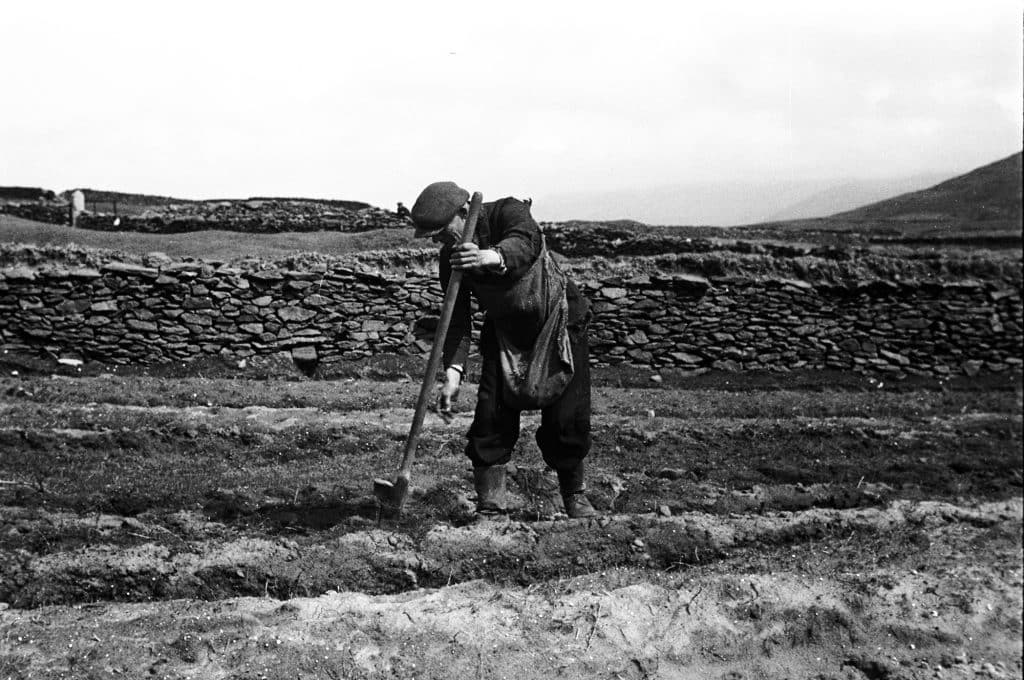
© National Folklore Collection, UCD.
It is a historical fact that the potato, more than any other crop, dominated the farming system of Ireland in general, and of West Cork in particular, all through the 19th century and indeed well into the 20th. The early variety in those days was either the ‘Red Elephant’ or the ‘Epicure’ and the beautiful yellow-tinted ‘Champion’ was the main crop, a potato of such perfection for table use that its equal has never since appeared despite the obvious attraction of ‘Kerr’s Pinks’ and the ‘Golden Wonder’ in our own time.
The potatoes were usually sown in a sound ‘bán’ (lea) field and the fences cleared of all bushes and briars. Several cartloads of farmyard manure was drawn out and spread over the field, manure that had accumulated during the previous winter when the cattle had been housed at night, their stalls cleaned out each morning and spread over the ‘aiteann Gaelach’ (Irish furze) and ‘raithineach’ (ferns) that had been cut and deposited over part of the farmyard. On Heir Island and the other islands of Roaringwater Bay and along the coast, seaweed was gathered from the strands and cut from the rocks, drawn to the fields in baskets on a donkey’s back. Each landholder had their section of shore marked, where they were allowed cut the ‘feamainn’ (seaweed).
With the manure spread over the surface the ploughing of the ridges began. At that time potatoes were grown exclusively in ridges, as they had been for more than a century before. The idea of sowing them in drills came in some time later. On Heir Island there was a practice of using three donkeys to plough. The next job was an exacting one, the hacking of the ridges, always with a ‘grafán’ – a type of strong hoe, no longer used. It was back-breaking, back-bending work.
The seed potatoes or sciolláns, as they were called, were cut, so that from a single potato you might get two or three seed. I can still clearly remember my parents cutting the ‘sciolláns’. After this was done the potatoes would be set. A pouch was fashioned from a half-sack meal bag in such a way that you had a very serviceable much into which you put the ‘sciolláns’ for planting. The pouch was called a ‘púca’ (pooka) which, of course, is also the Irish for a ghost. The hole for the ‘sciollán’ was made by a spade and the ‘sciolláns’ dropped into it, usually five ‘sciolláns’ across the width of the ridge. Closing the holes was done with a ‘pucadóir’ (also called a fairichín), which was a short block of timber with a handle attached.
Three weeks after came the first ‘earthing’ when earth from the furrows between the ridges was shovelled onto the ridge. Two weeks later the stalks appeared and two weeks after that the second earthing was done. The potatoes were usually sprayed against blight at least three times; this was a solution of blue-stone and washing soda, usually before blossoming, a fortnight after blossoming and a third spray in late July.
Digging the potatoes in ridges was done by a spade. The farmer dug them and they were picked into buckets and all the collected potatoes put in a pit. The pickers had to segregate the white potato from the black rotten ones, the fully developed potato from the ‘criochán’ (small potatoes). The half-criocháns were collected later and boiled for the pigs.
The potato-pit was a source of wonder and admiration for those who could never make one themselves. A well-made pit started as a shallow trench somewhere in the field. The potatoes were neatly traced up into a long narrow ridge-like pile, tapering evenly from ground level to a sharp-edged top. They were carefully covered with straw, or more often with ‘luachair’ rushes that grew in every big in West Cork. Then the real working began, the art of earthing the pit, with shovelful after shovelful of loose earth piled with eight inches deep over the potatoes, the two sides of the pit being built up at the same time until they met at the top in a perfect edge. Then the whole pit was patted smooth with the back of the shovel and the potatoes were safer than they would ever be in a house. The farmer usually took pride in his work – the potato pit had to be made skilfully; the rick of corn, the rick of hay, all were fashioned like works of art.
Patrick Kavanagh, the greatest poet of rural Ireland, mentions the potato-pit in his lovely nostalgic poem ‘A Christmas Childhood’: ‘One side of the potato-pits was white with frost / How wonderful that was, how wonderful!’
In ‘Spraying the Potatoes’, he writes: ‘The barrels of blue potato-spray stood on a headland of July and / The flocks of green potato-stalks / Were blossom spread for sudden flight, / The Kerr’s Pinks in a frilled blue, / The Arran Banners wearing white.