

Local physio and marathon runner, Darren Kelly
Dunmanway native Darren Kelly is rapidly making his mark on the marathon circuit, clocking a remarkable personal best of 2:50:03 at this year’s Dublin City Marathon. Niamh Coughlan shares how since taking up running seriously in 2023, Darren has already delivered impressive performances on some of the world’s most iconic running courses, including Boston, London, and both Dublin and Cork City Marathons.
“I’ve been a Dunmanway man all my life, really. I was a very active kid – back in those days you kind of had to be,” says Darren. “You were kicked out the door in the morning, and home time was when the street lights came on.” Darren always had a strong interest in field sports, and was very much involved with the Doheny GAA Club from the age of six or seven, later playing soccer with both Dunmanway Town FC and Togher FC.
Working as a physiotherapist at the West Cork Pain Relief Clinic, Darren shares how it was his own sporting injuries that steered him toward his career path. “I had a meniscus tear in my knee and underwent an arthroscopy. I had the same pain before and after the surgery, but I battled on for years playing football. It wasn’t until I started my physiotherapy course and became a patient for one of the older students, starting proper strength training, that the symptoms finally disappeared. I still wonder today if, had I done the strength training before the surgery, I might never have needed it at all.”
He only became interested in running in his early 30s. “When I was still involved in GAA and soccer, I’d enter the odd race here and there, but there was never any real training. I was definitely winging it.”
It wasn’t until 2023, his final year playing GAA, that running truly came to the forefront. “I always had an interest in it to some extent, but GAA and soccer always took priority. The marathon was on the bucket list, but I suppose I never really knew if I’d ever actually complete one.”
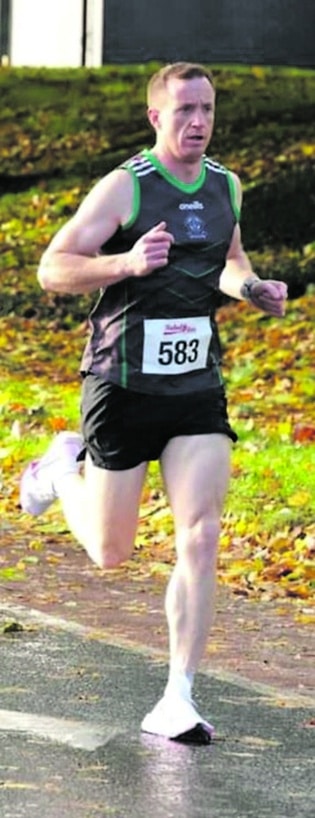
Darren’s GAA background proved to be a major advantage, providing the foundation for breaking into running. “Even though I played as a goalkeeper at adult level, I was always fit. Most players hated pre-season because it was all running, but I secretly loved it. I knew I could push myself. My first race was actually a half marathon in Clonakilty about six or seven years ago. It was winter, so there was no football. I went in with no training, thinking I’d be grand but I soon found out. It was a lot of hard work..”
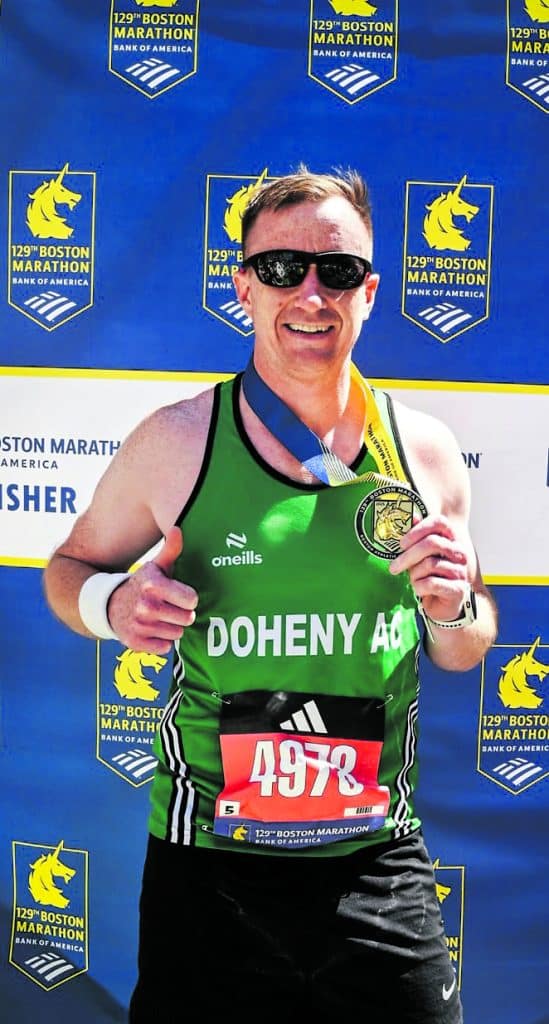
Completing his first marathon in April 2024, Darren had secured a place in the London Marathon through the CUH Charity around six or seven months earlier. He began training in September/October 2023 and went on to clock an impressive 2:57:30 in London, a time that qualified him for this year’s Boston Marathon, where he improved again with a 2:54:30 finish. To date, he has taken on London, Cork, Boston, and Dublin twice, recently achieving a personal best of 2:50:03 in the capital. “You’d think Boston would be the standout marathon and the city is incredible, but for atmosphere alone, London is the winner. The noise as I ran over Tower Bridge that day will stay with me for a very, very long time.”
The structured regime behind marathon training turned out to be far more intense than Darren expected. “When I started running as my number one sport, I thought it was a case of getting a pair of runners and off you go. The amount of work on everything else is crazy.”
In preparation for his most recent marathon, he was training six to seven days a week, mixing slow runs, intervals, tempo sessions, and long runs. “There was a spell where I was averaging 90-100 kilometres per week for about five or six weeks before the taper. I always tell the lads that if I’d trained this hard for football, I’d have been a grand player”.
And the marathons won’t end there. Darren hopes to add several more to his list before eventually hanging up the trainers. “Over the next few years, I’d love to take on a few more of the majors, Chicago, New York, Berlin – but of course, it all depends on staying injury-free”.
Despite being vigilant about prevention of injury, he has had his share of them, particularly lower-limb issues accumulated over years of GAA and soccer. He has dealt with a grade-2 hip flexor strain, a meniscus tear, and multiple ankle sprains. Since taking up running, however, he has been relatively lucky. “I’d only missed one week with injury until recently, when I suffered a stress fracture in my tibia during the Dublin Marathon. I had medial tibial stress syndrome (shin splints) leading up to the race, and I knew the risk I was taking before toeing the line. I ended up fracturing it during the race, so at the moment I’m off running while it heals. I’ve replaced my training with strength and conditioning, the bike, and the elliptical, and I’m hoping to return to pool running this week.”
He believes the strength-and-conditioning aspect of running is still widely underestimated. “I’d cut back on my gym time before the injury, and I genuinely think that if I’d kept it up, I might not have picked up this one.”
Darren runs with Doheny Athletics Club and often heads out with a few of its members when he can. David Mawe usually gets the text. Most of the time, though, his training is done solo, as his work hours don’t always line up with the club’s. “I don’t mind that, to be honest. Running is an individual sport, and you have to be self-driven to achieve your goals”.
West Cork is spoiled for choice when it comes to running routes, and one of Darren’s favourites is close to home. Every year, he helps organise the Dunmanway 10km Road Race. “If I didn’t mention that route as my favourite, I’d be in trouble!
“2026 will be our fourth year hosting the race since the committee came together to bring it back to life, and to date we’ve raised over €30,000 for local charities and amenities. It’s a fantastic course, taking in the town and the beautiful countryside around Dunmanway. There’s a nice challenging hill in the final kilometre, but once you hit the top it’s a fast downhill sprint to the finish. In fairness, the local community comes out in force every year, and that support creates a really special atmosphere on race day.”
As a physiotherapist, Darren’s day starts early, usually around 6:30 or 7am, before he heads to the clinic for a full day’s work. “I typically finish at 5 or 6pm, and then it’s time to train.” He’s grateful to have Dunmanway Swimming Pool nearby, which has become a key part of his routine. “If it’s dry, I’ll park the car there, head out for my run, and then go into the pool for a recovery session afterwards. If the weather is really bad, I’ll use the gym upstairs in the pool. I swear the staff there must be sick of the sight of me!”
Working with others comes naturally to Darren, though he’s still relatively new to sports physiotherapy. Each year he takes on a new 30-hour course in an area which is of interest to him. “I’ve been practicing nearly seven years now, and the research is always evolving. A lot of people who end up in the clinic have taken up running and are simply doing too much too soon. They pick up injuries because their bodies aren’t used to the stress they’re putting themselves under. Someone can go from living a fairly sedentary life to suddenly running three or four 5ks a week. The biggest tip I can give is to build slowly and to respect the easy-pace run.”
Recovery is just as important as training. “I’m very lucky to have the swimming pool locally, so I spend a lot of time there doing injury-prevention work, easy stretching, and mobility exercises after training. I don’t want to knock any recovery method, I think they all have a place, but there are four pillars of recovery that are often overlooked: sleep, hydration, nutrition, and stress management. You can do the best post-training routine ever, but if you’re skipping meals, eating junk food every night, or glued to your phone at 2am, you haven’t really recovered – you’ve just ticked a box. No amount of recovery boots or massage guns can replace these four pillars.”
As a runner and someone who works with runners, there is a mutual understanding just how impatient athletes can be when injured. “It’s all about setting different goals along the way, with the overall aim being a return to your sport. Nobody wants to be stuck doing a rehabilitation program, but that’s just part of life and injuries happen.”
Setting personal challenges is the key to improvement in running. “Unless you’re Jakob Ingebrigtsen, there’s always someone faster than you. Even locally, I know I’m unlikely to win a 10km, 10-mile, or half-marathon race, but I set goals for myself and aim to achieve them in each race. Continually hitting personal targets in anything has its own rewards.”
When he’s not working or training, Darren enjoys spending time with his partner, Amy. “She’s a very patient woman, putting up with all my training.” They often take her dog, Bailey, for walks or go out for dinner. “After that, I’m usually found watching sports, whether it’s GAA, Liverpool, athletics, or Formula 1.”
Although running is a major part of his lifestyle, Darren doesn’t let it overshadow everything. “I try not to talk about running unless someone asks. I know it could take over my whole personality, so I’m conscious around friends, family, and even patients in the clinic to keep it in check. Even doing this interview feels very different for me. I like to stay under the radar, but if it inspires even one person to take up running, it’s worth it.”
Looking ahead, 2026 already has exciting plans on the horizon. “I hope to run the Seville Marathon in February, but my comeback from injury will determine that. After that, I plan to take part in plenty of local runs across Cork over the spring and summer, before hopefully tackling another major marathon in the autumn. It’s shaping up to be another big year on the road.”